
Kabaddi
Kabaddi: From Mud Courts to Prime Time — The Full Story of India's Fastest-Growing Sport
कबड्डी सात-खिलाड़ी वाली दो टीमों का संपर्क खेल है, जो 13x10 मीटर के कोर्ट पर खेला जाता है। एक रेडर 'कबड्डी' का लगातार उच्चारण करते हुए विरोधी पाले में 30 सेकंड के भीतर बचावकर्ताओं को छूकर लौटता है। स्कोरिंग: छूने पर 1 अंक, बोनस लाइन (6+ बचावकर्ता होने पर) 1 अंक, ऑल आउट पर 2 अंक, 3 या कम बचावकर्ताओं के साथ टैकल पर 2 अंक (सुपर टैकल), और एक ही रेड में 3+ अंक पर सुपर रेड। प्रो कबड्डी लीग (पीकेएल) 2014 में मशाल स्पोर्ट्स द्वारा शुरू हुई, स्टार नेटवर्क से जुड़ी, जिसने फ्रैंचाइज़ी और नीलामी मॉडल को जन्म दिया। अंतरराष्ट्रीय स्तर पर भारत का ईरान के साथ मुख्य प्रतिद्वंद्विता है; ईरान ने 2018 एशियाई खेलों में पुरुष स्वर्ण जीता। बांग्लादेश में कबड्डी राष्ट्रीय खेल है। शासन ढाँचा आईकेएफ, एकेएफआई और मशाल स्पोर्ट्स पर आधारित है। कबड्डी की ओलंपिक दावेदारी (टोक्यो, पेरिस) अब तक असफल रही; महिला व्यावसायिक लीग का अभाव प्रमुख संरचनात्मक सीमा है।
In the crowded field of Indian sports, where cricket sits on the highest throne, there is another game that has been silently but steadily walking toward that throne over the last decade — kabaddi. A sport whose roots lie in village soil, in the dust of akharas and in centuries-old folk tradition, yet whose summit now reaches prime-time television, multi-crore auctions and Asian Games medals. Kabaddi today is not merely a sport; it is the story of India's most successful non-cricket commercial breakthrough, a model that has been copied by the leagues of wrestling, badminton and table tennis.
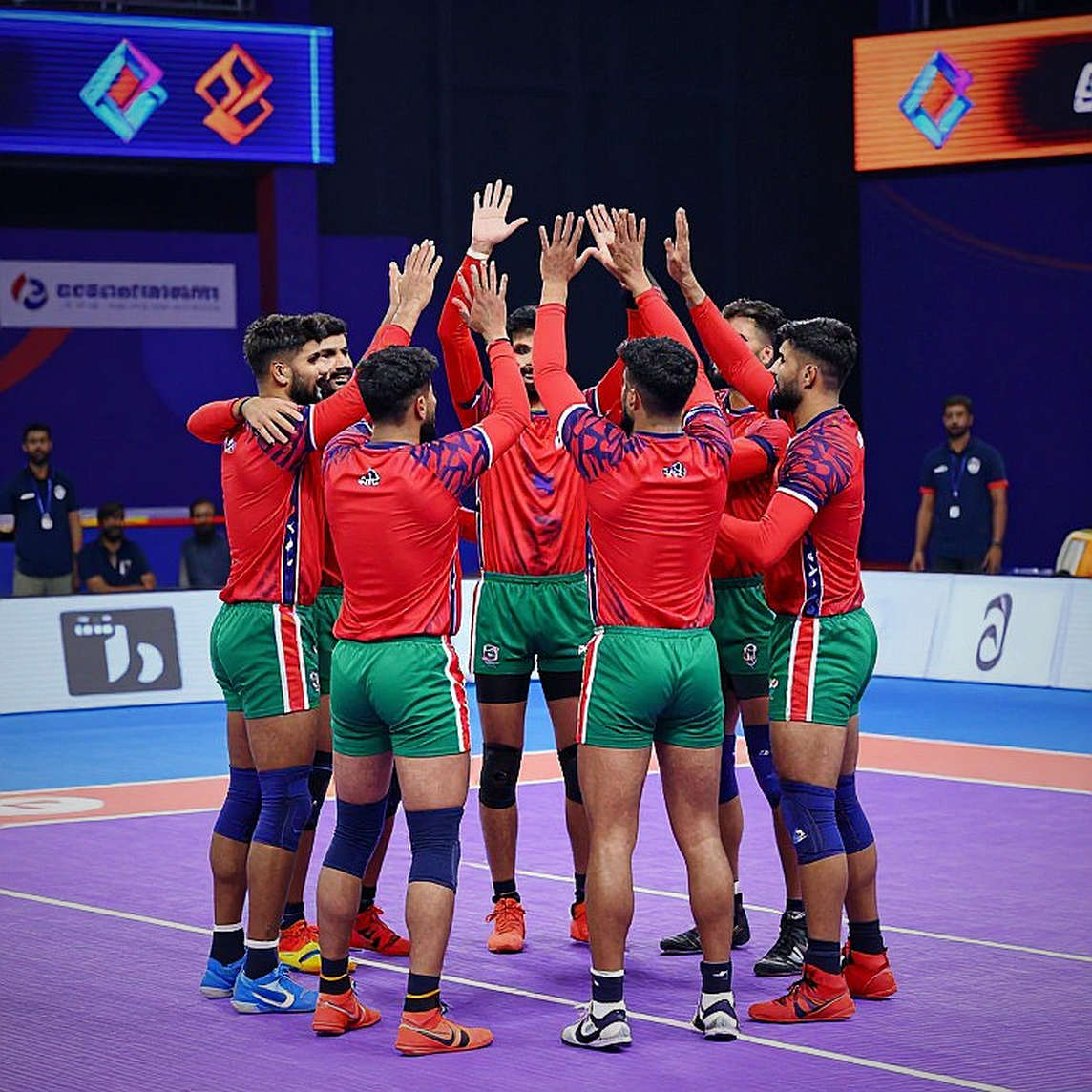
To understand the game, one must first know the rules. Kabaddi is a seven-a-side contact sport played on a 13m × 10m court. At any one time only one player — the raider — enters the opponent's half and, chanting 'kabaddi-kabaddi' without a break, tries to touch as many defenders as he can within 30 seconds and return safely. As long as the chant continues, the raider proves he is not pausing to inhale; the instant the chant breaks, the raid is void. This 'cant' is kabaddi's most distinctive and most fundamental condition — no holding the breath, no silence, the voice must be kept alive continuously.
The real drama lies in the scoring. Touching one person in the opponent's half earns a point; crossing the bonus line — but only when the defending side has six or more players on court — earns another point. When defenders stop and pin the raider in their own half, that is a 'tackle'; and if, at the time of defence, their own side has three or fewer players on court, that tackle is worth two points instead of one — a 'super tackle'. When every player on one team is dismissed, an 'all out' occurs, the opponent gets two extra points, and the entire dismissed team revives. This rebirth rule is what makes kabaddi theatrical — no lead can ever be considered safe.
It is precisely these rules that make kabaddi ideal for television. The 'do-or-die raid' rule states that after two consecutive empty raids, the third raid is mandatory-scoring — if it yields nothing, the raider himself is dismissed. This forces players to take risks and gives the viewer a decisive moment on every third raid. The bonus line rewards deep raids, and the all-out opens the door to a comeback — the combination of all three produces fast scoring and a momentum that keeps flipping, ideal for broadcast in short prime-time windows.
The credit for making this game modern, professional and viewer-centric goes to the Pro Kabaddi League (PKL), which began in 2026. Operated by Mashal Sports and tied to the Star television network, the league brought kabaddi into an urban franchise model for the first time. Teams named after cities, exciting commentary with TV highlights, and above all — the player auction, which for the first time gave kabaddi players a chance to earn crores of rupees. This is the same auction system that gave kabaddi recognition, because here, for the first time, a player's price and his raid-tackle statistics began to be compared in public.
The league also forged the stars of the sport. Names like Pawan Pathak, Anup Kumar, Rohit Kumar and Pardeep Narwal became the identity of kabaddi. Pardeep Narwal was long regarded as the gold standard of raiding — the combination of his raid success rate and points per match was rare. Anup Kumar and Rohit Kumar demonstrated the importance of strategy and versatility, while young raiders like Naveen Kumar showed that the new generation is not only faster but can succeed even against more unstable defences.
The defensive side is no less thrilling. Iranian defenders like Fazel Atrachali have proven that kabaddi is no longer an Indian-only sport. In defensive positions such as Corner, Cover and 'In', these players' intelligence can turn many matches. And the most thrilling moment of all comes when a single raid yields three or more points — a 'super raid', kabaddi's greatest crowd-pleasing event.
Within the league, the auction and draft do the work of keeping competition balanced. Teams like Patna Pirates built a dynastic dominance by stringing together long title runs, while other franchises raised the real question. Interestingly, new teams too keep getting opportunities in such a league, so neither is competition overwhelmingly fierce, nor does any single monopoly dominate. This is why the league is held up as an example of multi-power balance.
At the international level, the picture is not bipolar but almost unipolar — India long remained on top and Iran its permanent challenger. At the 2026 Jakarta Asian Games, Iran's men's team won gold, proving that India's dominance is no longer unbroken. Before that, from 2026 to 2026, India had won gold in the Asian Games continuously — a streak that Iran broke. Since then, India–Iran matches have become a permanent rivalry in which both numbers and politics are intertwined.
The picture in other countries is also interesting. In Bangladesh, kabaddi enjoys the status of the national game, with deep roots, though its professional structure lags. South Korea has gained rapid ground through systematic training and the experience of its players in the PKL, while Pakistan is known for the strength of its Circle Style and the fierce rivalry with India. Scattered development is also visible in countries like Nepal, Sri Lanka and Kenya.
Kabaddi's cultural identity in South Asia rests on three narratives. First, its claimed origin roughly four thousand years ago — presented as an 'earth-born, indigenous' alternative to the colonial game of cricket. Second, class mobility — most players come from poor rural families, and government jobs such as the railways, police and army become the main incentive to stay in the sport. Third, the gender dimension — women's kabaddi has Asian Games standing, but not a professional league like the men's. The PKL remains men-only, which is considered the sport's biggest structural gap.
Looking at the commercial structure, the PKL's revenue model depends most on media rights, historically concentrated in the Star/Disney Star network. Besides this come top sponsorship, ticketing and licensing. Ownership of the franchise teams rests largely with big Indian corporate groups and entertainment figures. The player auction is the key price-discovery mechanism, with A/B/C/D graded base prices and a separate pool of overseas players. But a risk hides here too — dependence on a single broadcaster and the decay of viewer novelty. Any commercial evaluation, therefore, requires at least one solid datum — a rights figure, a sponsor name, an auction price or a rating.
Looking at governance, the structure runs on three levels — the International Kabaddi Federation at the international level, the Amateur Kabaddi Federation of India (AKFI) domestically, and the league operator Mashal Sports. Historically, the AKFI has been surrounded by controversy, which is considered the weakest link in the sport's governance. In addition, anti-doping and the standardisation of officiating are areas where the demand for transparency keeps rising. Stability in governance is necessary also because a crisis in any federation can directly affect events and national-team participation.
On the road to the Olympics, kabaddi's journey has so far not succeeded. Bids for both Tokyo and Paris failed, because the IOC's key conditions — the sport's global geographical spread and a strong presence of the women's game — both still require work. This is why earning a place at the Olympics remains kabaddi's biggest future goal.
Broadly, kabaddi's challenges are clear. Injury load in defence, scoring dependence on a single raider, the bubble of excessive auction premiums, the unstable governance of the AKFI and repeated Olympic bid failures — these are all risks that need constant monitoring. But on the other side, what the sport has is no secret to anyone — high speed, repeatedly flipping momentum, a cheap structure and its unique cultural heritage tied to the soil. And that is precisely what makes this sport so special for a country like India, where the next game with crores of viewers is still searching for its roots.
Kabaddi's real story is not one of individual players but of a mechanism that turned a muddy field into prime time. That story is not yet complete — because until an equal professional platform is built for women and the Olympic door opens, kabaddi cannot realise its greatest potential. But looking at the speed at which the sport has grown, this question is no longer imagination but a matter of time.
संबंधित खिलाड़ी
लोकप्रिय/पसंदीदा पुस्तकें
The Regular-Season Number No Preview Prints: Do-or-Die Raid Conversion, Not Super 10s2026-11-15
Surjeet Singh as Captain, Naveen Kumar as Deputy: India’s Real Test at the 2026 Commonwealth Kabaddi Championship2026-11-13
Inaugural Commonwealth Kabaddi Championship in Ahmedabad: The Real Test for 2030 Starts Beyond the Mat2026-11-11
Inaugural Commonwealth Kabaddi Championship Begins in Ahmedabad; India Face Malaysia and England2026-11-07
Pakistan's Withdrawal Is the Symptom, Not the Story: The Real Weakness of the Ahmedabad Commonwealth Kabaddi Championship2026-11-06
अनुशंसित
Commonwealth Kabaddi Championship 2026: Surjeet Singh Captain, Naveen Kumar Vice-Captain — But That Is Not the Real Question2026-10-22
Haryana's Kabaddi Champions League: Expansion or Alternative Route?2026-11-08
Where Is the Kabaddi Story? An Empty Analysis Exposes the Biggest Weakness in Sports Reporting2026-11-08
Kabaddi Deep-Dive Report Requires Verifiable Source Material2026-11-07
Surjeet Singh Captain, Naveen Kumar Deputy: Strategic Questions Surround India’s Commonwealth Kabaddi Challenge2026-11-05
अनुशंसित
From 14 to 13: One Name Struck Off the Ahmedabad Entry List, and the Whole Medal Arithmetic Shifted2026-10-22
Kabaddi: A Seven-Player Game Where Breath and Strategy Are Both at Stake2026-11-02
Surjeet Singh Captain, Naveen Kumar Deputy: Strategic Questions Surround India’s Commonwealth Kabaddi Challenge2026-11-05
Surjeet Singh Captain, Naveen Kumar Deputy: At the Commonwealth Kabaddi Championship, India's Biggest Rival Isn't on the Mat2026-10-29
Kabaddi: From the Village Akhada to the Global Stage2026-11-02