
Asian Cricket
Abhishek Sharma's 35-Ball Century: India Chase Down 199 in 80 Balls at Wellington
अभिषेक शर्मा ने न्यूजीलैंड के खिलाफ वेलिंगटन में तीसरे टी20 अंतरराष्ट्रीय में केवल 35 गेंदों में शतक बनाया, जो उनका चौथा टी20 अंतरराष्ट्रीय शतक है। उनकी पारी में 20 बाउंड्री हिट्स रहीं जिनमें 11 छक्के शामिल थे, यानी केवल बाउंड्री से 102 रन बने और उनका बाउंड्री-शेयर 90 प्रतिशत से अधिक रहा। भारत ने न्यूजीलैंड के 198/3 के जवाब में 199 रन का लक्ष्य केवल 80 गेंदों यानी 13.2 ओवरों में दो विकेट खोकर हासिल किया, और मैच में 40 गेंदें शेष रहीं। भारत का पावरप्ले स्कोर 118/0 था, जो लगभग 19.7 रन प्रति ओवर है, और 10 ओवरों के बाद भारत 178/2 पर था। न्यूजीलैंड की ओर से डैरिल मिचेल ने 52 गेंदों पर नाबाद 89 रन बनाए, जबकि जैकब डफी के पहले ओवर में 26 रन गए जिसमें पांच वाइड और एक नो-बॉल शामिल था। इस जीत से भारत ने पांच मैचों की सीरीज़ में 3-0 की अजेय बढ़त बना ली। यह प्रदर्शन रिकॉर्ड-स्तरीय है, लेकिन इसका मूल्यांकन सच्ची उछाल वाली पिच, घूमती हुई प्रतिद्वंद्वी गेंदबाज़ी और पहले ही तय हो चुकी सीरीज़ के संदर्भ में करना चाहिए; शतक की सटीक गेंद-संख्या और रिकॉर्ड के दावे सत्यापन लंबित हैं।
Wellington: What India did in the third T20I of the five-match series against New Zealand was not merely a win — it was a performance that rewrote the working definition of a T20 powerplay. New Zealand made 198 for 3. India chased 199 in just 80 balls, losing two wickets. That is 13.2 overs. That is a rate of roughly 14.9 runs per over. Forty balls were left unused at the end — a single number that explains how completely the contest was flattened, and why India's middle order never had to face a single ball under pressure.
It was the third match of the series, and the win gave India an unassailable 3-0 lead. The direct implication is that the remaining two fixtures are now dead as contests and are likely to be used for rotation and experimentation. That context matters when judging the innings and the win: this was not India's best XI, and the opposition was not at full strength either.
The first chapter of the match belonged to the bowling, but its story is split in two. New Zealand raced to 88 for 1 in seven overs, which is to say India's seamers lost their lengths the moment the early movement disappeared. And yet New Zealand could add only 63 in their last seven overs, having been 135 in 13. India conceded just nine runs each in the 18th and 20th overs. So the death bowling was disciplined; the new-ball control was not. That is a signal buried under the scoreboard's glare.
For New Zealand, Daryl Mitchell made 89 not out off 52 balls, a strike rate of about 171. This is the most underrated data point of the match. Mitchell came into this innings after two poor games and made these runs against a near full-strength Indian attack. For any analyst, that is a form-recovery signal with a longer shelf life than the chase that grabbed the headlines. Around him, New Zealand's batting includes Allen, Seifert, Phillips and Jacobs, but 63 in the last seven overs suggests the order is thin once Mitchell is past.
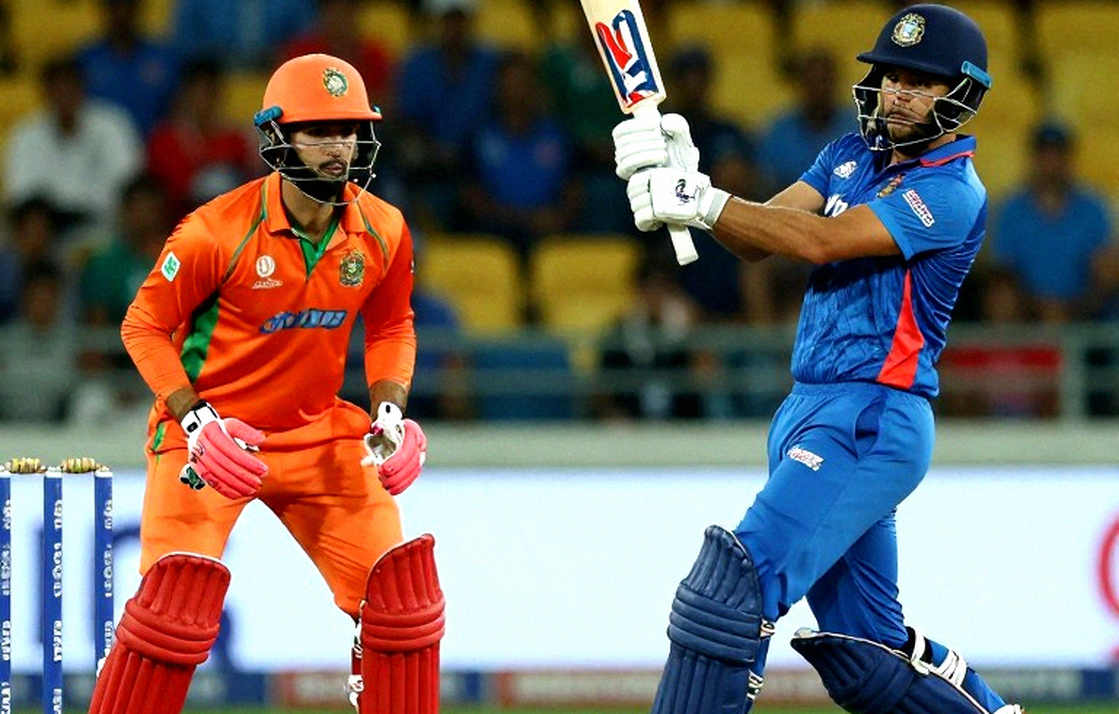
Now the part this match will be remembered for. Abhishek Sharma reached his century in just 35 balls. It was his fourth T20I hundred, which by itself is a statement about consistency. His innings contained 20 boundary hits, of which 11 were sixes. That means 102 runs came from fours and sixes alone. A very large share of his innings — plausibly above 90 percent, and by some readings nearly all of it — came in boundaries. This was not a good-strike-rate innings; it was a boundary-share outlier in which he converted almost every scoring opportunity into a four or a six.
His fifty came in roughly 15 balls, three short of Yuvraj Singh's 12-ball record. His strike rate in this innings would sit somewhere between 260 and 290, close to double the elite T20I powerplay benchmark. But a clear caveat is required: this figure is calculated, not verified from an official scorecard, and must be treated as pending verification.
A technical reading matters here, because the method that made him successful is also the method that defines his ceiling. His backlift is high, his batswing is generous, and his game leans heavily on hand-eye coordination. He backs away to the leg side to create room and hits short balls over the infield. That method is devastating as long as the ball is coming onto the bat — that is, when there is pace and bounce in the surface. But it has an identifiable failure mode: backing away exposes the stumps and the inside half of the bat. Against genuine 145kph-plus bowling with a wide-yorker or follow-him plan, or on slower, lower surfaces where there is no bounce to topple, the same method becomes a dismissal risk. This remains a hypothesis, but it cannot be ignored.
New Zealand's tactics, meanwhile, invite criticism. They bowled short, and shorter, to a batter who makes room and hits over the infield — precisely the length he wanted. The fielding captain looked as though the instructions had gone astray. When the short ball is the plan, the field must be set for the top edge and the pull to deep; that does not appear to have happened. This is a fair tactical criticism, not merely colour writing.
The real story of New Zealand's bowling lies in the first over. Jacob Duffy's opening over cost 26, including five wides and a no-ball — more than four extra deliveries in a match where the required rate was already under ten. That is a technical breakdown under pressure, not a tactical defeat. It handed India a free over and artificially reduced the difficulty of the chase. Which is why the 199 target was not as hard as it sounds.
Abhishek's opening partner Sooryavanshi also contributed meaningfully, though the report does not give his exact score. On the available evidence he made roughly 40 off a sub-25-ball innings inside a 133-run stand in which Abhishek was the dominant partner, and which contained 23 boundaries. His style can be described as raw power with a dangerous simplicity: see the ball, hit the ball. But a second aspect of his temperament was visible when he showed open frustration at two consecutive dot balls. That is a double-edged trait: it keeps intent high, but it also predicts forced shots when boundaries dry up. It is a temperament signal, not just a style note.
On his age and experience level, the first report carried nothing. If he is the teenage left-hander tracked in India's age-group circuit, workload and safeguarding considerations become immediately material. This point requires verification, not assumption.
India's bowling structure offered a mixed picture. Axar Patel was used as the spin control option and the selection was seam-heavy. Death-over discipline was visible — nine runs each in the 18th and 20th overs — but powerplay control was not. India also failed to bowl New Zealand out; 198 for 3 suggests the attack lacked a wicket-taking option through the middle overs on a flat deck. New Zealand tried pace, spin and different field settings without success. That points to a plan-execution gap rather than a plan-selection gap.
Now to the record claims. The figures cited in the first report are internally inconsistent and should be treated as pending verification. On one hand there is a firm claim of the fastest team hundred; on the other, a hedge about available records. Either a record is established or it is not; both cannot be true at once. Similarly, the phrase describing Abhishek's hundred as his second quickest T20I century is ambiguous — it could mean his personal second-fastest, or the second-fastest in T20I history. These are very different claims requiring different verification. Equally, Abhishek's final score is never stated and can only be approximated at 102 or more from his boundary count. In the age of breaking news, inflating numbers has become a habit, and that habit damages both media credibility and player valuation.
Other hidden details matter too. The toss result is not recorded anywhere. On a surface this true, the toss is unlikely to have been decisive — bat-first sides at short-boundary venues often prefer to set a target, which suggests New Zealand chose to bat. The winning margin in wickets is likewise unstated, but with two dismissals the most likely result is a win by eight wickets with 40 balls remaining. There is no explicit venue information either, though the innings profile — 23 boundaries inside a 133-run stand and batters dominating the bounce — points to a true-bounce, short-boundary surface. Nothing is said about weather, dew or wind, so no conclusion can be drawn on those.
From a selection-policy standpoint the match offers several signals. The presence of Prince Yadav, Naman Dhir and Nitish Kumar Reddy in a live series indicates a deep rotation pool. Winning away from home, with a rotated XI, and by this margin, shows that the gap between India's A and B sides is currently large. This should be read as a selection-policy signal rather than a final verdict on India's strength. It is equally true that the middle order never batted under pressure across this series. Three chases were finished by the openers, which means positions four to seven have no recent pressure innings behind them. The remaining two matches should be used to force that exposure deliberately.
On New Zealand, it would be wrong to say they lacked ideas. The report itself concedes that the bowlers were not short of ideas but were running out of deliveries the openers would respect — a polite way of describing a bowling unit with no reliable control option. By contrast, New Zealand's death bowling was genuinely good and is being ignored because of the result. Conceding 63 in the last seven overs after 135 in the first 13 is a strong closing performance; in a normal match, that is the winning adjustment.
At the commercial level, the real impact of this innings will be felt in the auction room, not on the field. An Indian top-order batter who can strike above 200 is the scarcest commodity in the franchise market, because Indian players are not subject to overseas-player quotas in the IPL. That is the single most important commercial asymmetry in world T20 cricket. But a clear distinction must be drawn: this is commercial value transmission, not sporting-value proof. A high auction price would reflect scarcity and market structure, not evidence of international dominance. And there is a clear risk: if the fifty and hundred record claims prove inaccurate, the resulting valuation bump will be built on a statistical error.
It should also be acknowledged that bilateral T20I series are increasingly functioning as audition infrastructure for the franchise economy. Their sporting meaning is diluted by volume, but their scouting and price-discovery function keeps growing. This match is a textbook case. Broadcast and streaming audiences for this fixture will be heavily India-weighted, and its commercial value will be driven largely by the Indian diaspora and Indian-market digital clips rather than New Zealand gate revenue.
At the governance level, no controversy is recorded in this match. There is no DRS dispute, no Duckworth-Lewis-Stern intervention, no Mankad incident and no mention of an over-rate sanction. The five wides and no-ball are a discipline matter, not a rule matter. On integrity, there are no abnormal signals either; a one-sided bilateral T20I in a series already decided lacks the incentive structures — points tables and qualification — that correlate with fixing risk. The real governance question is player workload. A five-match series, domestic commitments and a franchise calendar is a heavy load for an opening batter who also fields. The binding constraint here is the BCCI's rest-management policy, not the ICC rulebook.
From a risk standpoint, the biggest threat is not this match but the conclusions drawn from it. India's new-ball bowling came under control only after the movement disappeared, having conceded 88 for 1 in seven overs; a stronger opening pair could convert that into 220-plus. The second risk is the surface dependence of Abhishek's method; the third is the untested middle order; the fourth is the discipline of New Zealand's opening bowling; the fifth is overuse and burnout risk for a very young opener; and the sixth is that auction valuation will move on one innings rather than multi-season data.
At the public-narrative level, this match has reached the climax of a hype cycle. The report's own register — extraordinary beyond belief, no target matters, the match reduced to a mismatch — is the textual signature of a hype peak. The facts in the report are objective; the framing is subjective. Every data point is checkable, every adjective is inflationary. That combination is the classic precursor to a backlash cycle. The claim that no target matters is the weakest link in the narrative because it is falsifiable: on a slower surface against a disciplined attack, targets absolutely matter. Meanwhile, invoking Yuvraj Singh's 12-ball fifty ties the innings to a 2026 World Cup moment — a comparison frame with a historically low fulfilment rate.
In conclusion, chasing 199 in 80 balls at Wellington is a genuine record-class powerplay performance, headlined by a 35-ball hundred with 20 boundary hits. But its analytical weight is bounded by a true surface, a rotated opposition attack that gifted an over of 26 runs, and a series already won. The more durable signals lie elsewhere — India's fragile new-ball control, their untested middle order, and New Zealand's excellent death bowling that the result has erased from view. Abhishek's innings should be filed as a demonstration of capability, not the establishment of a new baseline. And until he faces a slow surface and an elite wide-yorker plan, a format-defining verdict should be withheld. Note: this report is based on a single source whose publication date was not recorded; the century's exact ball count, the batter's final score, the second opener's contribution, the winning margin and the toss are all derived rather than stated and should be treated as pending verification.
संबंधित खिलाड़ी
लोकप्रिय/पसंदीदा पुस्तकें
From 184/7 to 386: Towhid Hridoy's 242* Rewrites Bangladesh's Record Book, But the Spreadsheet Is Still Quiet2026-11-15
Marnus Labuschagne Faces a Difficult Selection Turn: The Road Back Through Domestic Cricket2026-11-14
Lahore Smog Forces Pakistan-Sri Lanka Second Test to Rawalpindi2026-11-13
Ledger Before Legend: Four Names in Pakistan's Test Squad, and One Sum That Doesn't Add Up2026-11-13
अनुशंसित
Asia's New Cricket Geography: The Hybrid Model, Revenue Politics and the Rise of the Associates2026-11-10
Asia's Cricket Ledger and Its Shadow Paragraph: The Second XI, the ACC Table, and the Name the Scoreboard Never Records2026-11-02
Empty Ledger, Loud Dates: What the Absence of a Document Says About Asian Cricket Coverage2026-11-12
“Salman Bhai, We Are Live”: Salman Butt’s On-Air Slip and the Story Behind the Viral Clip2026-11-11
Sylhet Toss Exposes Leadership Truth: Chase's 'Bat First' Gamble and the Hidden Risk Inside Bangladesh's Spin Wall2026-11-06
अनुशंसित
Hardik Pandya Trade: Punjab's Lure, Rajasthan's Move, and Mumbai's Real Need2026-11-05
Services Take Control Against Delhi, but the Reported 202-Run Lead Needs a Scorecard Audit2026-11-05
₹14.5 Crore and Zero Facts: The Empty Payload of Transfer-Window Reporting2026-10-30
No Cricket Report Without a Source: The Available Analysis Records Only an Information Gap2026-11-13
The 240-Ball Ledger: What Kohli's 8,741 Chase Runs Actually Prove — And What They Don't2026-11-05